


2026 Updated Verified Pass AB-100 Exam - Real Questions and Answers
Dumps Moneyack Guarantee - AB-100 Dumps Approved Dumps
NEW QUESTION # 28
A startup wants to build a customizable, agent-based workflow that can integrate with their internal APIs, retrieve contextual data from various sources, and run complex business logic autonomously. The team has moderate engineering skills but explicitly wants to avoid the overhead of managing underlying infrastructure. Which Microsoft AI service model best fits this requirement for building and deploying their agent-based solution?
- A. IaaS (VM-based custom AI workloads on Azure Virtual Machines)
- B. SaaS (Microsoft 365 Copilot)
- C. Dynamics 365 Customer Service Workspace
- D. PaaS (Microsoft Foundry + Azure OpenAI + Azure AI Search + Prompt Flow)
Answer: D
NEW QUESTION # 29
Note: This section contains one or more sets of questions with the same scenario and problem. Each question presents a unique solution to the problem. You must determine whether the solution meets the stated goals. More than one solution in the set might solve the problem. It is also possible that none of the solutions in the set solve the problem.
After you answer a question in this section, you will NOT be able to return. As a result, these questions do not appear on the Review Screen.
A key stakeholder in your organization is championing the immediate deployment of Microsoft Copilot across all business units. Their primary justification is the belief that AI will automatically generate superior, data-driven decisions starting on day one, irrespective of the current state of organizational data quality or the alignment of existing business processes. You are tasked with providing an accurate assessment of this claim based on industry guidance, particularly Microsoft's "AI for Business" principles.
Based on Microsoft's "AI for Business" guidance, can you confidently state that deploying AI tools like Copilot will lead to better decisions with having a foundation of quality business data and well- defined, aligned workflows first?
- A. Yes
- B. No
Answer: B
Explanation:
While Microsoft's "AI for Business" guidance indeed emphasizes that AI can enable better decision-making, it critically states that this capability is not automatic or instantaneous. Instead, it explicitly requires several foundational elements:
Processing large volumes of relevant, quality business data: AI tools like Copilot depend heavily on access to accurate, comprehensive, and well-structured organizational data to derive meaningful insights. Without quality data, the AI lacks the necessary inputs to provide intelligent, contextual, or reliable outputs.
Uncovering patterns: AI's strength lies in identifying patterns and correlations within data that human analysis might miss. This process is futile if the underlying data is incomplete, inaccurate, or unstructured.
Aligning the technology to business workflows: For AI-generated insights to translate into genuinely "better decisions," they must be integrated into and relevant to existing business processes. Deploying AI in a vacuum, without considering how it fits into and enhances current workflows, will diminish its practical value and impact on decision-making.
Therefore, deploying AI tools like Copilot without an existing foundation of quality data and aligned processes will not automatically guarantee improved decisions. The AI will lack the essential context and reliable inputs needed to generate meaningful insights and drive effective outcomes.
References:
https://www.microsoft.com/en-in/microsoft-copilot/copilot-101/ai-for-
business#Customerexperience
https://www.microsoft.com/en-in/microsoft-365/business-insights-ideas/resources/grow-your- small-business-with-artificial-intelligence
NEW QUESTION # 30
A company has a Microsoft Copilot Studio agent that provides answers based on a knowledge base for customer support.
Users report that, occasionally, the agent provides inaccurate answers.
You need to use metrics from the Analytics tab in Copilot Studio to identify the cause of the inaccuracies.
Which two options should you use? Each correct answer presents part of the solution.
NOTE: Each correct selection is worth one point.
- A. topic usage and topics with low resolution
- B. survey results
- C. quality of generated answers
- D. engagement, resolution, and escalation rates
- E. session information and session outcomes
Answer: A,D
Explanation:
[C]
You can use the Analytics dashboard to identify and fix inaccurate responses by focusing on specific performance signals:
*-> Topics with Low Resolution: This metric identifies individual topics where sessions frequently end without a successful outcome. A low resolution rate often indicates that the topic's logic is flawed, the content is outdated, or it fails to address the user's specific intent.
*-> Topic Usage: High usage of certain topics combined with low resolution or high escalation rates points to critical knowledge gaps. Use this to prioritize which parts of your knowledge base need immediate refinement.
Unrecognized Utterances: Review these to find user phrases that didn't trigger any custom topic, indicating missing content or the need for new trigger phrases.
Analyze User Questions by Theme: Copilot Studio uses AI to group generative responses into themes. You can review these clusters to see which themes have poor response quality and need better grounding or data hygiene.
User Feedback (Thumbs Up/Down): Review specific messages with negative feedback in the Analytics tab to understand exactly where the AI is hallucinating or providing incomplete data.
[D]
In Microsoft Copilot Studio, you can use analytics to pinpoint why your agent is providing inaccurate answers by following a structured improvement checklist.
Using Metrics to Locate Problems
*-> Engagement Rate: A low engagement rate often indicates that your triggers are misconfigured or too broad, causing the agent to initiate the wrong topic or fail to recognize user intent entirely.
*-> Resolution Rate: Identify specific topics with low resolution. If a topic has a high volume of sessions but fails to reach a "Resolved" state, it usually means the knowledge source is outdated, mismatched, or the generative answers are not grounded properly.
*-> Escalation Rate: High escalation rates for particular topics are "red flag" drivers. Use the Escalation Rate Drivers chart to see which topics most frequently force a hand-off to a human agent, indicating where the AI's knowledge or logic is insufficient.
Reference:
https://learn.microsoft.com/en-au/microsoft-copilot-studio/guidance/analytics
https://support.accelevents.com/en/articles/5456691-session-analytics
NEW QUESTION # 31
You are designing a low-code AI business solution by using Microsoft Copilot Studio.
The solution must include an agent that automates tasks by simulating user interactions across third-party apps and websites, such as clicking buttons, entering text, and extracting information from screens.
You need to recommend what to include in the agent.
What should you recommend?
- A. a natural language understanding + (NLU+) model in Copilot Studio
- B. Copilot skills
- C. Model Context Protocol (MCP)
- D. Computer Use in Copilot Studio
Answer: D
Explanation:
In Microsoft Copilot Studio, you can use the computer use tool (currently in preview) to build low- code agents that automate tasks by simulating human interactions on a Windows computer.
Key Capabilities of Computer Use
UI Interaction: Agents can interact with any system featuring a graphical user interface (GUI), including third-party websites and desktop applications.
*-> Human-like Actions: The tool enables the agent to click buttons, select menus, enter text into fields, and scroll, mimicking a human user.
No API Required: It is particularly useful for automating legacy systems or applications that lack direct API connectors.
Vision-Based Reasoning: Powered by Computer-Using Agents (CUA), the tool uses AI to "see" the screen, allowing it to adapt in real time if button positions or layouts change.
*-> Low-Code Setup: You define what the agent should do using natural language instructions rather than complex coding.
Reference:
https://learn.microsoft.com/en-us/microsoft-copilot-studio/computer-use
NEW QUESTION # 32
A company has an AI solution built by using Microsoft Copilot Studio and Power Platform. The solution is used by the company's sales, marketing, and customer service teams.
You are performing a return on AI investment (ROAI) analysis to evaluate the impact of the solution.
You need to identify which measurable business drivers to include in the analysis.
Which two business drivers should you identify? Each correct answer presents part of the solution.
NOTE: Each correct selection is worth one point.
- A. the reduced average case resolution time
- B. economic market predictability
- C. brand awareness
- D. increased employee productivity
- E. market capitalization
Answer: A,D
Explanation:
Reducing the average case resolution time is a high-impact, measurable business driver for an AI investment (ROAI) analysis, particularly when implementing Microsoft Copilot Studio and Power Platform for local sales, marketing, and customer service teams.
According to Microsoft and industry research, this metric directly translates to reduced operational costs, increased agent productivity, and higher customer satisfaction.
Increased employee productivity is a primary and highly measurable business driver for an AI investment (ROAI) analysis involving Microsoft Copilot Studio and Power Platform, particularly for sales, marketing, and customer service teams. These tools allow organizations to automate manual tasks, streamline workflows, and enhance content generation, directly resulting in time savings and efficiency gains.
Reference:
https://www.stratospherenetworks.com/blog/tech-talks-reduce-resolution-times-by-40-with-ai-for- customer-service-agents
https://www.microsoft.com/en-in/microsoft-copilot/copilot-101/ai-for-business
NEW QUESTION # 33
A company plans to deploy an AI-based customer service app that will autonomously manage interactions, escalate complex cases, and learn from historical ticket data.
You need to perform a return on AI investment (ROAI) analysis of the app deployment. The solution must ensure that the analysis is accurate.
What should you do first?
- A. Identify and quantify all the development, deployment, and operating costs.
- B. Conduct an AI market benchmarking study.
- C. Establish the AI performance metrics.
- D. Model the customer experience.
Answer: A
Explanation:
To conduct a robust Return on AI Investment (ROAI) analysis for your Microsoft-based AI customer service application, you must first categorize and quantify three distinct cost phases:
Development, Deployment, and Operations. For a system capable of managing complex escalations and learning from historical data, your project aligns with "Advanced" or "Agentic" AI profiles.
1. Development Costs (Upfront Investment)
This phase covers the creation of the core AI logic, custom integrations, and data preparation.
2. Deployment Costs (One-Time Setup)
These are the costs to move the application from a development environment to a live production state.
3. Operating & Maintenance Costs (Recurring)
Ongoing expenses are critical for ROAI as they impact the net gain over time.
Reference:
https://emerline.com/blog/ai-app-development-cost
NEW QUESTION # 34
Note: This section contains one or more sets of questions with the same scenario and problem. Each question presents a unique solution to the problem. You must determine whether the solution meets the stated goals. More than one solution in the set might solve the problem. It is also possible that none of the solutions in the set solve the problem.
After you answer a question in this section, you will NOT be able to return. As a result, these questions do not appear on the Review Screen.
A company uses Microsoft 365 and Dynamics 365.
You need to recommend a solution to automatically summarize email threads, generate suggested replies in Microsoft Outlook, and provide meeting preparation summaries that include relevant customer relationship management (CRM) data.
Solution: You recommend Microsoft 365 Copilot for Sales.
Does this meet the goal?
- A. No
- B. Yes
Answer: B
Explanation:
Correct:
* You recommend Microsoft 365 Copilot for Sales.
Incorrect:
* You recommend a classic Microsoft Dataverse workflow.
* You recommend a Microsoft 365 Copilot agent template.
Note:
In the described scenario, Microsoft 365 Copilot for Sales acts as the primary bridge between your productivity tools and CRM data. It integrates directly into Microsoft Outlook and Teams to surface real-time insights from Dynamics 365 Sales or Salesforce.
Key capabilities for this specific workflow include:
Automated Email Summarization: Copilot scans long email threads in Outlook to extract key points, highlights, and BANT (Budget, Authority, Need, Timeline) data. If the sender is an external contact recognized in your CRM, the summary is automatically enriched with relevant account and opportunity data.
Suggested Email Replies: When replying to customer emails, Copilot generates drafts based on the context of the conversation and existing CRM data. You can use predefined response categories (e.g., "Reply to an inquiry," "Offer a proposal") or custom prompts to include specific opportunity details in the draft.
Meeting Preparation Summaries: Before a scheduled meeting, Copilot for Sales provides a
"preparation card" in Teams or Outlook. This summary includes:
- CRM Data: Matched opportunity and account attributes.
- Contextual History: Summaries of past email exchanges and the last three seller notes.
- Strategic Insights: Key risks, follow-up actions, and discussion points from previous interactions.
Reference:
https://msdynamicsworld.com/blog/microsoft-copilot-sales-close-deals-faster-ai
NEW QUESTION # 35
A company has a customer order system that creates sales orders manually.
You need to design an AI solution to automate the following tasks as part of the system:
- Save the order details to a database.
- Update the order status in the database.
- Extract the order details from an order file.
- Prepare and send a confirmation email to customers.
The solution must minimize development effort and support intelligent automation and solution integration.
What should you include in the design?
- A. a multi-agent solution that uses the Semantic Kernel SDK
- B. a workflow in Azure Logic Apps
- C. a multi-agent solution that uses Microsoft Foundry Agent Service
- D. a Microsoft Copilot Studio agent that uses Microsoft Power Automate workflows
Answer: D
Explanation:
To create this system, you'll need to integrate Microsoft Copilot Studio with Power Automate and AI Builder. This combination allows your agent to not only "talk" but also "act" by executing complex backend workflows.
Solution Architecture
Front-end: A Copilot Studio agent serves as the interface, receiving order requests or files from customers.
Brain (Logic): Power Automate cloud flows act as the "skills" for your agent, handling all database and email operations.
Data Extraction: AI Builder (Document Processing) extracts specific fields (like Item ID, Quantity, or Customer Name) from uploaded order files.
Storage: Microsoft Dataverse or SQL Server functions as the database to save and update order records.
Reference:
https://medium.com/@sushmita.sg/build-an-ai-powered-customer-support-system-in-2-hours-no- code-using-microsoft-copilot-2e3275dbbee5
NEW QUESTION # 36
A company has a Microsoft Copilot Studio agent that uses custom connectors to interact with enterprise APIs.
You need to recommend an application lifecycle management (ALM) process to ensure that the connectors are deployed consistently across development, test, and production environments and meet governance and traceability requirements.
What should you recommend?
- A. Maintain connector definitions in environment variables.
- B. Export and import the connectors between the environments as unmanaged solutions.
- C. Deploy the APIs as Azure Functions.
- D. Manage the connectors as solution components and deploy the components by using ALM pipelines.
Answer: A
Explanation:
To implement a robust Application Lifecycle Management (ALM) process for Microsoft Copilot Studio agents using custom connectors, you must leverage Solutions and Environment Variables to ensure consistency and governance.
1. Solution-Based Management
Always develop your custom connectors and Copilot Studio agents within a Power Platform Solution. This allows you to package all related components (connectors, environment variables, and agents) as a single unit for deployment across your ALM pipeline (Dev → Test → Prod).
2. Implementing Environment Variables
To maintain consistent definitions and meet governance requirements, externalize environment- specific values using Environment Variables:
Host and Base URL: Use environment variables for the API endpoint (e.g., api.dev.enterprise.com vs. api.prod.enterprise.com) to avoid manual edits during deployment.
Security Credentials: For OAuth settings like Client ID and Client Secret, use environment variables with the Secret data type.
Azure Key Vault Integration: For high-security enterprise APIs, store secrets in Azure Key Vault and reference them via secret environment variables to ensure traceability and governance.
Reference:
https://learn.microsoft.com/en-us/copilot/finance/get-started/custom%20connectors/custom- connectors-solutions
NEW QUESTION # 37
A company has an AI solution that uses Azure OpenAI models.
You need to recommend a governance solution that monitors and audits changes to model configurations and data usage. The solution must minimize administrative effort.
What should you include in the recommendation?
- A. Azure API Management
- B. Microsoft Purview
- C. Azure Stream Analytics
- D. Azure Monitor
- E. Azure Policy
Answer: D
Explanation:
Azure Monitor is the primary service for monitoring and auditing Azure OpenAI model configurations and data usage. By combining Azure Monitor with diagnostic settings, you can track management operations, analyze token consumption, and audit prompt/response data.
Reference:
https://learn.microsoft.com/en-us/azure/azure-monitor/fundamentals/overview
NEW QUESTION # 38
Hotspot Question
You need to design a multi-agent solution that will include a custom agent. The solution must meet the following requirements:
- Define the rules and constraints that the agent must follow.
- Automate a backend process that involves data movement between
services and runs independently of the agent's reasoning steps.
What should you include in the design for each requirement? To answer, select the appropriate options in the answer area.
NOTE: Each correct selection is worth one point.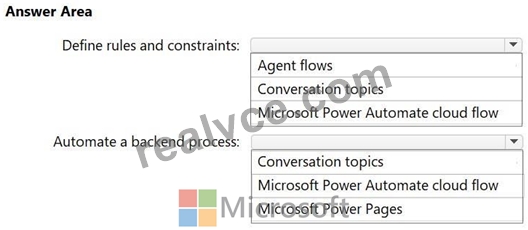
Answer:
Explanation: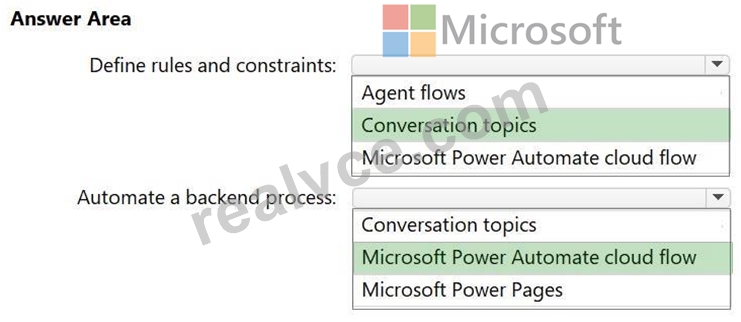
Explanation:
Box 1: Conversation topics
Define the rules and constraints that the agent must follow.
In a Microsoft AI project using Microsoft Copilot Studio, you define the rules, constraints, and dialogue paths for a custom agent primarily through Topics. Topics act as the agent's
"competencies," determining how a conversation plays out based on specific user intents.
To use topics for defining agent behavior and constraints, follow these core principles:
Define Conversation Paths: Use topics to map out discrete, structured paths for the agent to follow. This allows you to enforce specific procedures, such as user verification, before providing sensitive information.
Set Triggers: Each topic begins with a trigger (phrases, keywords, or events) that signals when the agent should switch to a specific set of rules or logic.
Enforce Logic via Nodes: Within a topic, use nodes-such as questions, conditions, and actions-to define the logic, variables, and branching paths the agent must follow.
Modularize with "Bite-size" Topics: Break down complex agent logic into smaller, manageable topics. You can use the Redirect node to pass the conversation (and its constraints) from one topic to another.
Handle Errors and Fallbacks: Use System Topics (like On Error or Escalate) to define how the agent should behave when it hits a constraint it cannot resolve or fails to understand a query.
Box 2: Microsoft Power Automate cloud flow
Automate a backend process that involves data movement between services and runs independently of the agent's reasoning steps.
In a Microsoft multi-agent project, you can use Power Automate cloud flows to handle backend data movement independently of an agent's reasoning steps. This approach is often referred to as classic orchestration.
By offloading structured, rule-based tasks to a cloud flow, you ensure that high-volume data operations or multi-service integrations remain deterministic and reliable, while your custom agents focus on dynamic, probabilistic decision-making.
Reference:
https://learn.microsoft.com/en-us/microsoft-copilot-studio/guidance/topics-overview
https://companial.com/blog/unlocking-intelligent-automation
NEW QUESTION # 39
Case Study 1 - Fabrikam, Inc
Background
Fabrikam, Inc., is a global consumer goods company that is undergoing a digital transformation initiative to migrate its entire infrastructure to the Microsoft cloud. As a key element of this cloud migration, the company will implement Microsoft Dynamics 365 Sales, moving away from the current on-premises proprietary technologies used by its business-to-business (B2B) sales team.
As part of the cloud migration, Fabrikam will adopt an AI-first approach to its business solutions and implement AI solutions, wherever possible, to streamline operations.
Problem Statements
Fabrikam's infrastructure currently relies on various on-premises systems that require sales executives to use corporate computers with physical keyboards to access business information during customer interactions. Mobile phones cannot be used for these purposes, as the systems depend on keyboard input. As a result, the sales executives spend a lot of time using keyboards to search for data on several disparate systems and file servers, rather than focusing on the customers. This affects the customer experience.
Fabrikam stakeholders are concerned that users will be hesitant to adopt AI. If the AI initiatives are NOT adopted, cost savings will never be realized. Additionally, funding for future AI initiatives will depend on demonstrating an increase in AI adoption month over month. As the AI agent initiative for the sales team will be the first for Fabrikam, the rapid adoption of the agent is a high priority.
Planned Initiatives
General
Fabrikam management has prioritized AI-driven projects to improve efficiency, customer engagement, and responsible AI adoption. The current application infrastructure is on-premises and must be migrated to the cloud to support the adoption of these technologies.
Infrastructure Migration
Fabrikam plans to migrate from its current on-premises infrastructure to a completely cloud-based topology; this will include user authentication, the security framework, and, primarily, the adoption of the services by end users.
All the data from the different systems will be consolidated into a single data source - a common data model that will use a Microsoft Dataverse environment as a single source of truth (SSOT) for the sales team.
Sales Cycle Enablement
To achieve the company's objectives, Fabrikam intends to implement the following strategies to enhance the sales cycle:
- Use low-code development to create a single AI agent that has
Dataverse as its core component.
- Ensure that sales managers can access unanswered correspondence from
prospects and intervene as appropriate.
- Replace the previous proprietary software with Dynamics 365 Sales to
track sales cycles and customer interactions.
- Have the sales executives use Dynamics 365 Sales to track
interactions for open opportunities and send follow-up communications
to prospects.
- Have the sales executives use handsfree headsets to interact with an
AI agent when they have questions about internal policies or customer
data.
Requirements
Infrastructure Migration
Fabrikam has identified the following infrastructure migration requirements:
- Azure must be used for all future infrastructure workloads.
- The company must follow Microsoft-recommended methodologies for
infrastructure migration to the cloud.
- Any created AI agents must have their return on investment (ROI)
calculated to ensure that the solution will save the company money.
Sales Cycle Enablement
Fabrikam has identified the following requirements for sales cycle enablement:
- The final AI agent must follow Microsoft recommendations for a
conversational user experience.
- A designated checklist must be reviewed to ensure that the AI agent
follows Microsoft deployment recommendations for a compliant solution.
- Detailed telemetry must be logged for the first created AI agent to
help troubleshoot and optimize the agent during the initial AI agent
adoption process.
- Unexpected AI agent actions must end in an escalation to a live
representative. For example, a sales executive must be rerouted to a
representative if the agent cannot answer a question after two failed
attempts.
- The return on investment (ROI) of switching from the current process
to the future process is required for stakeholder sign off.
- The sales team must use Dynamics 365 Sales to correspond with
prospects more quickly and efficiently than currently.
- Sales managers must report on the adoption of the AI agent to key
Fabrikam stakeholders on a monthly basis.
- Any sensitive information, such as user IDs and names, shared via the AI agent must be tracked for future auditing.
Which framework should you use for the infrastructure migration?
- A. Microsoft Power Platform Project Setup Wizard
- B. Success by Design
- C. Microsoft Power Platform Center of Excellence (CoE)
- D. Microsoft Cloud Adoption Framework for Azure
Answer: D
Explanation:
For migrating a legacy on-premises infrastructure to Microsoft Dynamics 365 Sales with Dataverse as the Single Source of Truth (SSOT), the recommended framework is the Microsoft Cloud Adoption Framework for Azure (CAF), specifically utilized in conjunction with the Data Management Framework (DMF) for Dynamics 365.
This combined approach ensures a structured transition by focusing on both the strategic adoption of cloud technology and the technical, granular migration of data.
Recommended Framework: Microsoft Cloud Adoption Framework (CAF)
The CAF provides a holistic structure to ensure the migration is secure, compliant, and aligned with business goals.
Plan: Assess legacy data, prioritize workloads, and define the SSOT requirements.
Ready: Set up the Dataverse environment (landing zone) and configure security (Azure Active Directory/Microsoft Entra ID).
Adopt (Migrate): Perform the technical migration of data using ETL (Extract, Transform, Load) processes.
Scenario:
Infrastructure Migration
Fabrikam plans to migrate from its current on-premises infrastructure to a completely cloud-based topology; this will include user authentication, the security framework, and, primarily, the adoption of the services by end users.
All the data from the different systems will be consolidated into a single data source - a common data model that will use a Microsoft Dataverse environment as a single source of truth (SSOT) for the sales team.
Background
Fabrikam, Inc., is a global consumer goods company that is undergoing a digital transformation initiative to migrate its entire infrastructure to the Microsoft cloud. As a key element of this cloud migration, the company will implement Microsoft Dynamics 365 Sales, moving away from the current on-premises proprietary technologies used by its business-to-business (B2B) sales team.
Reference:
https://learn.microsoft.com/en-us/azure/cloud-adoption-framework/overview
NEW QUESTION # 40
Case Study 1 - Fabrikam, Inc
Background
Fabrikam, Inc., is a global consumer goods company that is undergoing a digital transformation initiative to migrate its entire infrastructure to the Microsoft cloud. As a key element of this cloud migration, the company will implement Microsoft Dynamics 365 Sales, moving away from the current on-premises proprietary technologies used by its business-to-business (B2B) sales team.
As part of the cloud migration, Fabrikam will adopt an AI-first approach to its business solutions and implement AI solutions, wherever possible, to streamline operations.
Problem Statements
Fabrikam's infrastructure currently relies on various on-premises systems that require sales executives to use corporate computers with physical keyboards to access business information during customer interactions. Mobile phones cannot be used for these purposes, as the systems depend on keyboard input. As a result, the sales executives spend a lot of time using keyboards to search for data on several disparate systems and file servers, rather than focusing on the customers. This affects the customer experience.
Fabrikam stakeholders are concerned that users will be hesitant to adopt AI. If the AI initiatives are NOT adopted, cost savings will never be realized. Additionally, funding for future AI initiatives will depend on demonstrating an increase in AI adoption month over month. As the AI agent initiative for the sales team will be the first for Fabrikam, the rapid adoption of the agent is a high priority.
Planned Initiatives
General
Fabrikam management has prioritized AI-driven projects to improve efficiency, customer engagement, and responsible AI adoption. The current application infrastructure is on-premises and must be migrated to the cloud to support the adoption of these technologies.
Infrastructure Migration
Fabrikam plans to migrate from its current on-premises infrastructure to a completely cloud-based topology; this will include user authentication, the security framework, and, primarily, the adoption of the services by end users.
All the data from the different systems will be consolidated into a single data source - a common data model that will use a Microsoft Dataverse environment as a single source of truth (SSOT) for the sales team.
Sales Cycle Enablement
To achieve the company's objectives, Fabrikam intends to implement the following strategies to enhance the sales cycle:
- Use low-code development to create a single AI agent that has
Dataverse as its core component.
- Ensure that sales managers can access unanswered correspondence from
prospects and intervene as appropriate.
- Replace the previous proprietary software with Dynamics 365 Sales to
track sales cycles and customer interactions.
- Have the sales executives use Dynamics 365 Sales to track
interactions for open opportunities and send follow-up communications
to prospects.
- Have the sales executives use handsfree headsets to interact with an
AI agent when they have questions about internal policies or customer
data.
Requirements
Infrastructure Migration
Fabrikam has identified the following infrastructure migration requirements:
- Azure must be used for all future infrastructure workloads.
- The company must follow Microsoft-recommended methodologies for
infrastructure migration to the cloud.
- Any created AI agents must have their return on investment (ROI)
calculated to ensure that the solution will save the company money.
Sales Cycle Enablement
Fabrikam has identified the following requirements for sales cycle enablement:
- The final AI agent must follow Microsoft recommendations for a
conversational user experience.
- A designated checklist must be reviewed to ensure that the AI agent
follows Microsoft deployment recommendations for a compliant solution.
- Detailed telemetry must be logged for the first created AI agent to
help troubleshoot and optimize the agent during the initial AI agent
adoption process.
- Unexpected AI agent actions must end in an escalation to a live
representative. For example, a sales executive must be rerouted to a
representative if the agent cannot answer a question after two failed
attempts.
- The return on investment (ROI) of switching from the current process
to the future process is required for stakeholder sign off.
- The sales team must use Dynamics 365 Sales to correspond with
prospects more quickly and efficiently than currently.
- Sales managers must report on the adoption of the AI agent to key
Fabrikam stakeholders on a monthly basis.
- Any sensitive information, such as user IDs and names, shared via the AI agent must be tracked for future auditing.
Which template should you use for the AI agent to meet the requirements for the sales executives?
- A. Voice in Microsoft Copilot Studio
- B. IT Helpdesk in Microsoft Copilot Studio
- C. AI agents in Microsoft Foundry
- D. AI chat in Microsoft Foundry
Answer: A
Explanation:
Scenario:
Sales Cycle Enablement
To achieve the company's objectives, Fabrikam intends to implement the following strategies to enhance the sales cycle:
Have the sales executives use Dynamics 365 Sales to track interactions for open opportunities and send follow-up communications to prospects.
*-> Have the sales executives use handsfree headsets to interact with an AI agent when they have questions about internal policies or customer data.
To enable handsfree headset interaction with an AI agent for internal policies and customer data in Dynamics 365 Sales, you should use Microsoft Copilot Studio to create a custom agent template.
Here is the breakdown of the recommended approach and templates:
Recommended Template
Voice-enabled agent template (in Copilot Studio): This template provides the foundational, pre- configured setup for Interactive Voice Response (IVR) capabilities, allowing for natural language voice inputs and text-to-speech output.
Internal Data Knowledge Source: Within this agent, you will connect to Dataverse (for customer data) and configure Knowledge Sources (for internal policy documents).
Note:
To implement a hands-free AI agent for Dynamics 365 Sales using the Voice agent template in Microsoft Copilot Studio, follow these steps to enable voice-first interactions for internal policies and customer data.
1. Create a Voice-Enabled Agent
2. Configure Hands-Free Interaction
3. Connect to Internal Data
Reference:
https://learn.microsoft.com/en-us/dynamics365/contact-center/administer/bot-scenario-configure
NEW QUESTION # 41
You need to recommend a Microsoft Power Platform business solution that consolidates data from multiple internal and external data sources. The solution must meet the following requirements:
- Provide the data as a centralized source for multiple AI systems,
including Microsoft Copilot Studio agents, Dynamics 365 applications,
and external AI models.
- Support built-in data classification and protection policies.
- Provide data for grounding and analytics.
What should you include in the recommendation?
- A. a Microsoft Power BI semantic model
- B. Azure Data Lake Storage
- C. Azure Cosmos DB
- D. Microsoft Dataverse
Answer: D
Explanation:
Microsoft Dataverse is the ideal foundational component for this scenario, serving as the secure, centralized data platform for the Microsoft Power Platform, Dynamics 365, and AI integrations. By using Dataverse, the business can consolidate, protect, and utilize data across Copilot Studio agents, Dynamics 365 applications, and analytics tools, addressing all stated requirements.
Here is how Dataverse fulfills the requirements in the described scenario:
Centralized Source: It serves as the primary data storage and management engine for Power Platform, Dynamics 365, and Copilot Studio. It consolidates data into a unified data model (Common Data Model), ensuring consistency across internal and external sources.
Internal & External Integration: Dataverse supports data integration from diverse sources using tools like Power Query, Azure Data Factory, and virtual tables that map external data in real-time.
Data Classification & Protection: It features built-in, enterprise-grade security.
AI Grounding & Analytics:
- Grounding: It acts as the knowledge source for Copilot Studio agents, providing the necessary business context for accurate generative AI responses.
- Analytics: It integrates natively with Power BI for reporting and can synchronize with Microsoft Fabric or Azure Synapse for large-scale data modeling and advanced analytics.
Reference:
https://avantiico.com/solutions/microsoft-platforms/microsoft-dataverse
NEW QUESTION # 42
A company has Microsoft Foundry agents that generate responses by using Azure OpenAI resources. The agents are deployed to both the United States and Europe.
A company mandate states that the agents and their grounding data must adhere to data residency and movement regulations.
You need to recommend a governance solution for the agents.
What should you include in the recommendation?
- A. Azure Monitor
- B. Microsoft Defender for Cloud
- C. Microsoft Purview
- D. Azure Policy
Answer: C
Explanation:
In this scenario, Microsoft Foundry agents and Azure OpenAI resources generate responses by using the Responses API. To ensure these agents adhere to data residency and movement regulations across the United States and Europe, Microsoft Purview should be included to provide the following governance and security controls:
Unified Data Discovery & Classification: Purview's discovery REST API allows orchestrator agents to identify relevant data assets (e.g., in Fabric or Databricks) across the organization's entire data landscape.
Sensitivity Label Enforcement: It ensures that AI-generated responses respect existing access controls by checking document label metadata at query time. This prevents oversharing of sensitive data and restricts users to authorized content.
Data Loss Prevention (DLP): By integrating Purview DLP policies, organizations can monitor, block, or warn when sensitive data is used in AI prompts or responses in real-time.
Data Residency Compliance: For strict European residency (e.g., GDPR), Azure OpenAI resources should be deployed using Data Zone (DZ) SKUs (such as in Sweden Central or Germany West Central), which contractually guarantee that both data storage and processing remain within the specified geography.
Embedded Governance: Admins can enable a native integration within Microsoft AI Foundry at the subscription level. This automatically sends prompt and response data to Purview for auditing and compliance without requiring additional developer code.
Reference:
https://www.georgeollis.com/consuming-a-microsoft-foundry-agent-programmatically
NEW QUESTION # 43
......
Updated PDF (New 2026) Actual Microsoft AB-100 Exam Questions: https://pass4sures.realvce.com/AB-100-VCE-file.html