


PDF (New 2025) Actual Microsoft DP-600 Exam Questions
Dumps Moneyack Guarantee - DP-600 Dumps UpTo 90% Off
Microsoft DP-600 Exam Syllabus Topics:
| Topic | Details |
|---|---|
| Topic 1 |
|
| Topic 2 |
|
| Topic 3 |
|
NEW QUESTION # 69
You have a Fabric tenant that contains a complex semantic model. The model is based on a star schema and contains many tables, including a fact table named Sales. You need to create a diagram of the model. The diagram must contain only the Sales table and related tables. What should you use from Microsoft Power Bl Desktop?
- A. Data view
- B. Model view
- C. data categories
- D. DAX query view
Answer: B
Explanation:
To create a diagram that contains only the Sales table and related tables, you should use the Model view (C) in Microsoft Power BI Desktop. This view allows you to visualize and manage the relationships between tables within your semantic model. Reference = Microsoft Power BI Desktop documentation outlines the functionalities available in Model view for managing semantic models.
NEW QUESTION # 70
You have a Fabric tenant that contains a workspace named Workspace1 and a user named User1. User1 is assigned the Contributor role for Workspace1.
You plan to configure Workspace1 to use an Azure DevOps repository for version control.
You need to ensure that User1 can commit items to the repository.
Which two settings should you enable for User1? Each correct answer presents part of the solution.
NOTE: Each correct selection is worth one point.
- A. Users can synchronize workspace items with their Git repositories
- B. Users can create Fabric items
- C. Users can sync workspace items with GitHub repositories
- D. Users can create and use Data workflows
Answer: A,B
NEW QUESTION # 71
Drag and Drop Question
You have a Fabric workspace named Workspace1.
You have three groups named Group1, Group2, and Group3.
You need to assign a workspace role to each group. The solution must follow the principle of least privilege and meet the following requirements:
- Group1 must be able to write data to Workspace1, but be unable to add members to Workspace1.
- Group2 must be able to configure and maintain the settings of
Workspace1.
- Group3 must be able to write data and add members to Workspace1, but
be unable to delete Workspace1.
Which workspace role should you assign to each group? To answer, drag the appropriate roles to the correct groups. Each role may be used once, more than once, or not at all. You may need to drag the split bar between panes or scroll to view content.
NOTE: Each correct selection is worth one point.
Answer:
Explanation:
NEW QUESTION # 72
You have a Microsoft Power BI project that contains a semantic model.
You plan to use Azure DevOps for version control.
You need to modify the .gitignore file to prevent the data values from the data sources from being pushed to the repository.
Which file should you reference?
- A. cache.abf
- B. unappliedChanges.json
- C. model.bim
- D. localSettings.json
Answer: A
Explanation:
Justification: This file contains the cached data for the semantic model. It is a binary file and can be very large. Excluding this file from version control is necessary to prevent pushing large amounts of unnecessary data, and will prevent data from data sources from being pushed to the repository.
NEW QUESTION # 73
You have a Fabric tenant that contains a warehouse. The warehouse uses row-level security (RLS). You create a Direct Lake semantic model that uses the Delta tables and RLS of the warehouse. When users interact with a report built from the model, which mode will be used by the DAX queries?
- A. Dual
- B. Import
- C. Direct Lake
- D. DirectQuery
Answer: C
NEW QUESTION # 74
Case Study 2 - Litware, Inc
Overview
Litware, Inc. is a manufacturing company that has offices throughout North America. The analytics team at Litware contains data engineers, analytics engineers, data analysts, and data scientists.
Existing Environment
Fabric Environment
Litware has been using a Microsoft Power BI tenant for three years. Litware has NOT enabled any Fabric capacities and features.
Available Data
Litware has data that must be analyzed as shown in the following table.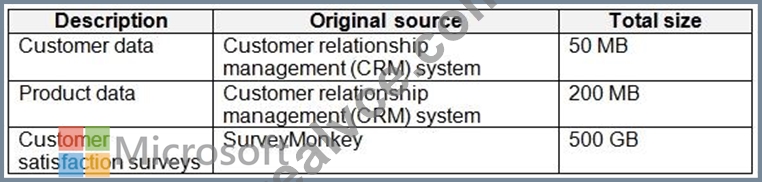
The Product data contains a single table and the following columns.
The customer satisfaction data contains the following tables:
- Survey
- Question
- Response
For each survey submitted, the following occurs:
- One row is added to the Survey table.
- One row is added to the Response table for each question in the survey.
- The Question table contains the text of each survey question. The third question in each survey response is an overall satisfaction score. Customers can submit a survey after each purchase.
User Problems
The analytics team has large volumes of data, some of which is semi-structured. The team wants to use Fabric to create a new data store.
Product data is often classified into three pricing groups: high, medium, and low. This logic is implemented in several databases and semantic models, but the logic does NOT always match across implementations.
Requirements
Planned Changes
Litware plans to enable Fabric features in the existing tenant. The analytics team will create a new data store as a proof of concept (PoC). The remaining Liware users will only get access to the Fabric features once the PoC is complete. The PoC will be completed by using a Fabric trial capacity The following three workspaces will be created:
- AnalyticsPOC: Will contain the data store, semantic models, reports pipelines, dataflow, and notebooks used to populate the data store
- DataEngPOC: Will contain all the pipelines, dataflows, and notebooks used to populate OneLake
- DataSciPOC: Will contain all the notebooks and reports created by the data scientists The following will be created in the AnalyticsPOC workspace:
- A data store (type to be decided)
- A custom semantic model
- A default semantic model
Interactive reports
The data engineers will create data pipelines to load data to OneLake either hourly or daily depending on the data source. The analytics engineers will create processes to ingest, transform, and load the data to the data store in the AnalyticsPOC workspace daily. Whenever possible, the data engineers will use low-code tools for data ingestion. The choice of which data cleansing and transformation tools to use will be at the data engineers' discretion.
All the semantic models and reports in the Analytics POC workspace will use the data store as the sole data source.
Technical Requirements
The data store must support the following:
- Read access by using T-SQL or Python
- Semi-structured and unstructured data
- Row-level security (RLS) for users executing T-SQL queries
Files loaded by the data engineers to OneLake will be stored in the Parquet format and will meet Delta Lake specifications.
Data will be loaded without transformation in one area of the AnalyticsPOC data store. The data will then be cleansed, merged, and transformed into a dimensional model The data load process must ensure that the raw and cleansed data is updated completely before populating the dimensional model The dimensional model must contain a date dimension. There is no existing data source for the date dimension. The Litware fiscal year matches the calendar year. The date dimension must always contain dates from 2010 through the end of the current year.
The product pricing group logic must be maintained by the analytics engineers in a single location. The pricing group data must be made available in the data store for T-SOL. queries and in the default semantic model. The following logic must be used:
- List prices that are less than or equal to 50 are in the low pricing group.
- List prices that are greater than 50 and less than or equal to 1,000 are in the medium pricing group.
- List prices that are greater than 1,000 are in the high pricing group.
Security Requirements
Only Fabric administrators and the analytics team must be able to see the Fabric items created as part of the PoC.
Litware identifies the following security requirements for the Fabric items in the AnalyticsPOC workspace:
- Fabric administrators will be the workspace administrators.
- The data engineers must be able to read from and write to the data store. No access must be granted to datasets or reports.
- The analytics engineers must be able to read from, write to, and create schemas in the data store. They also must be able to create and share semantic models with the data analysts and view and modify all reports in the workspace.
- The data scientists must be able to read from the data store, but not write to it. They will access the data by using a Spark notebook
- The data analysts must have read access to only the dimensional model objects in the data store. They also must have access to create Power BI reports by using the semantic models created by the analytics engineers.
- The date dimension must be available to all users of the data store.
- The principle of least privilege must be followed.
Both the default and custom semantic models must include only tables or views from the dimensional model in the data store. Litware already has the following Microsoft Entra security groups:
FabricAdmins: Fabric administrators
- AnalyticsTeam: All the members of the analytics team
- DataAnalysts: The data analysts on the analytics team
- DataScientists: The data scientists on the analytics team
- DataEngineers: The data engineers on the analytics team
- AnalyticsEngineers: The analytics engineers on the analytics team
Report Requirements
The data analysts must create a customer satisfaction report that meets the following requirements:
- Enables a user to select a product to filter customer survey responses to only those who have purchased that product.
- Displays the average overall satisfaction score of all the surveys submitted during the last 12 months up to a selected dat.
- Shows data as soon as the data is updated in the data store.
- Ensures that the report and the semantic model only contain data from the current and previous year.
- Ensures that the report respects any table-level security specified in the source data store.
- Minimizes the execution time of report queries.
Hotspot Question
You need to assign permissions for the data store in the AnalyticsPOC workspace. The solution must meet the security requirements.
Which additional permissions should you assign when you share the data store? To answer, select the appropriate options in the answer area.
NOTE: Each correct selection is worth one point.
Answer:
Explanation:
NEW QUESTION # 75
You have a Fabric workspace named Workspace1 that contains a data flow named Dataflow1 contains a query that returns the data shown in the following exhibit.
You need to transform the data columns into attribute-value pairs, where columns become rows.
You select the VendorID column.
Which transformation should you select from the context menu of the VendorID column?
- A. Split column
- B. Unpivot columns
- C. Remove other columns
- D. Group by
- E. Unpivot other columns
Answer: E
NEW QUESTION # 76
You have a Fabric workspace named Workspace1 and an Azure SQL database.
You plan to create a dataflow that will read data from the database, and then transform the data by performing an inner join. You need to ignore spaces in the values when performing the inner join The solution must minimize development effort. What should you do?
- A. Merge the queries by using fuzzy matching.
- B. Append the queries by using fuzzy matching.
- C. Append the queries by using a lookup table.
- D. Merge the queries by using a lookup table.
Answer: A
NEW QUESTION # 77
You have a Fabric workspace that contains a DirectQuery semantic model. The model queries a data source that has 500 million rows.
You have a Microsoft Power Bl report named Report1 that uses the model. Report! contains visuals on multiple pages.
You need to reduce the query execution time for the visuals on all the pages.
What are two features that you can use? Each correct answer presents a complete solution.
NOTE: Each correct answer is worth one point.
- A. user-defined aggregations
- B. automatic aggregation
- C. OneLake integration
- D. query caching
Answer: C,D
Explanation:
User-defined aggregations (A) and query caching (C) are two features that can help reduce query execution time. User-defined aggregations allow precalculation of large datasets, and query caching stores the results of queries temporarily to speed up future queries. References = Microsoft Power BI documentation on performance optimization offers in-depth knowledge on these features.
NEW QUESTION # 78
You have a Fabric tenant that contains a data pipeline.
You need to ensure that the pipeline runs every four hours on Mondays and Fridays.
To what should you set Repeat for the schedule?
- A. Daily
- B. Hourly
- C. Weekly
- D. By the minute
Answer: C
Explanation:
You should set Repeat for the schedule to Weekly (C). This allows you to specify the pipeline to run on specific days of the week, in this case, every four hours on Mondays and Fridays. References = Scheduling options for data pipelines are available in the Azure Data Factory documentation, which includes details on configuring recurring triggers.
NEW QUESTION # 79
You plan to deploy Microsoft Power BI items by using Fabric deployment pipelines. You have a deployment pipeline that contains three stages named Development, Test, and Production. A workspace is assigned to each stage.
You need to provide Power BI developers with access to the pipeline. The solution must meet the following requirements:
- Ensure that the developers can deploy items to the workspaces for
Development and Test.
- Prevent the developers from deploying items to the workspace for
Production.
- Follow the principle of least privilege.
Which three levels of access should you assign to the developers? Each correct answer presents part of the solution.
NOTE: Each correct answer is worth one point.
- A. Contributor access to the Production workspace
- B. Admin access to the deployment pipeline
- C. Viewer access to the Production workspace
- D. Build permission to the production semantic models
- E. Contributor access to the Development and Test workspaces
- F. Viewer access to the Development and Test workspaces
Answer: C,D,E
NEW QUESTION # 80
You have a data warehouse that contains a table named Stage. Customers. Stage-Customers contains all the customer record updates from a customer relationship management (CRM) system. There can be multiple updates per customer You need to write a T-SQL query that will return the customer ID, name, postal code, and the last updated time of the most recent row for each customer ID.
How should you complete the code? To answer, select the appropriate options in the answer area, NOTE Each correct selection is worth one point.
Answer:
Explanation:
Explanation:
* In the ROW_NUMBER() function, choose OVER (PARTITION BY CustomerID ORDER BY LastUpdated DESC).
* In the WHERE clause, choose WHERE X = 1.
To select the most recent row for each customer ID, you use the ROW_NUMBER() window function partitioned by CustomerID and ordered by LastUpdated in descending order. This will assign a row number of 1 to the most recent update for each customer. By selecting rows where the row number (X) is 1, you get the latest update per customer.
References =
* Use the OVER clause to aggregate data per partition
* Use window functions
NEW QUESTION # 81
You are analyzing customer purchases in a Fabric notebook by using PySpanc You have the following DataFrames:
You need to join the DataFrames on the customer_id column. The solution must minimize data shuffling. You write the following code.
Which code should you run to populate the results DataFrame?
- A.

- B.

- C.

- D.

Answer: C
Explanation:
The correct code to populate the results DataFrame with minimal data shuffling is Option A. Using the broadcast function in PySpark is a way to minimize data movement by broadcasting the smaller DataFrame ( customers) to each node in the cluster. This is ideal when one DataFrame is much smaller than the other, as in this case with customers. References = You can refer to the official Apache Spark documentation for more details on joins and the broadcast hint.
NEW QUESTION # 82
Note: This question is part of a series of questions that present the same scenario. Each question in the series contains a unique solution that might meet the stated goals. Some question sets might have more than one correct solution, while others might not have a correct solution.
After you answer a question in this section, you will NOT be able to return to it. As a result, these questions will not appear in the review screen.
You have a Fabric tenant that contains a lakehouse named Lakehousel. Lakehousel contains a Delta table named Customer.
When you query Customer, you discover that the query is slow to execute. You suspect that maintenance was NOT performed on the table.
You need to identify whether maintenance tasks were performed on Customer.
Solution: You run the following Spark SQL statement:
DESCRIBE DETAIL customer
Does this meet the goal?
- A. Yes
- B. No
Answer: B
NEW QUESTION # 83
You are creating a dataflow in Fabric to ingest data from an Azure SQL database by using a T-SQL statement.
You need to ensure that any foldable Power Query transformation steps are processed by the Microsoft SQL Server engine.
How should you complete the code? To answer, drag the appropriate values to the correct targets. Each value may be used once, more than once, or not at all. You may need to drag the split bar between panes or scroll to view content.
NOTE: Each correct selection is worth one point.
Answer:
Explanation:
NEW QUESTION # 84
......
Updated May-2025 Pass DP-600 Exam - Real Practice Test Questions: https://pass4sures.realvce.com/DP-600-VCE-file.html