


Download Online VALID DP-420 Exam Dumps File Instantly[Feb 12, 2023]
DP-420 Exam Dumps For Certification Exam Preparation
NEW QUESTION 11
Note: This question is part of a series of questions that present the same scenario. Each question in the series contains a unique solution that might meet the stated goals. Some question sets might have more than one correct solution, while others might not have a correct solution.
After you answer a question in this section, you will NOT be able to return to it. As a result, these questions will not appear in the review screen.
You have a container named container1 in an Azure Cosmos DB Core (SQL) API account.
You need to make the contents of container1 available as reference data for an Azure Stream Analytics job.
Solution: You create an Azure Data Factory pipeline that uses Azure Cosmos DB Core (SQL) API as the input and Azure Blob Storage as the output.
Does this meet the goal?
- A. Yes
- B. No
Answer: B
Explanation:
Instead create an Azure function that uses Azure Cosmos DB Core (SQL) API change feed as a trigger and Azure event hub as the output.
The Azure Cosmos DB change feed is a mechanism to get a continuous and incremental feed of records from an Azure Cosmos container as those records are being created or modified. Change feed support works by listening to container for any changes. It then outputs the sorted list of documents that were changed in the order in which they were modified.
The following diagram represents the data flow and components involved in the solution:
NEW QUESTION 12
You have an Azure Cosmos DB Core (SQL) API account that is configured for multi-region writes. The account contains a database that has two containers named container1 and container2.
The following is a sample of a document in container1:
{
"customerId": 1234,
"firstName": "John",
"lastName": "Smith",
"policyYear": 2021
}
The following is a sample of a document in container2:
{
"gpsId": 1234,
"latitude": 38.8951,
"longitude": -77.0364
}
You need to configure conflict resolution to meet the following requirements:
For container1 you must resolve conflicts by using the highest value for policyYear.
For container2 you must resolve conflicts by accepting the distance closest to latitude: 40.730610 and longitude: -73.935242.
Administrative effort must be minimized to implement the solution.
What should you configure for each container? To answer, drag the appropriate configurations to the correct containers. Each configuration may be used once, more than once, or not at all. You may need to drag the split bar between panes or scroll to view content.
NOTE: Each correct selection is worth one point.
Answer:
Explanation:
Reference:
https://docs.microsoft.com/en-us/azure/cosmos-db/conflict-resolution-policies
https://docs.microsoft.com/en-us/azure/cosmos-db/sql/how-to-manage-conflicts
NEW QUESTION 13
You have an Azure Cosmos DB Core (SQL) API account that is used by 10 web apps.
You need to analyze the data stored in the account by using Apache Spark to create machine learning models. The solution must NOT affect the performance of the web apps.
Which two actions should you perform? Each correct answer presents part of the solution.
NOTE: Each correct selection is worth one point.
- A. Create a private endpoint connection to the account.
- B. In an Azure Synapse Analytics serverless SQL pool, create a view that uses OPENROWSET and the CosmosDB provider.
- C. Enable Azure Synapse Link for the account and Analytical store on the container.
- D. In an Apache Spark pool in Azure Synapse, create a table that uses cosmos.oltp as the data source.
- E. In an Apache Spark pool in Azure Synapse, create a table that uses cosmos.olap as the data source.
Answer: C,E
Explanation:
Reference:
https://github.com/microsoft/MCW-Cosmos-DB-Real-Time-Advanced-Analytics/blob/main/Hands-on%20lab/HOL%20step-by%20step%20-%20Cosmos%20DB%20real-time%20advanced%20analytics.md
NEW QUESTION 14
The settings for a container in an Azure Cosmos DB Core (SQL) API account are configured as shown in the following exhibit.
Which statement describes the configuration of the container?
- A. Items stored in the collection will be retained always, regardless of the items time to live value.
- B. All items will be deleted after one hour.
- C. All items will be deleted after one year.
- D. Items stored in the collection will expire only if the item has a time to live value.
Answer: D
Explanation:
When DefaultTimeToLive is -1 then your Time to Live setting is On (No default) Time to Live on a container, if present and the value is set to "-1", it is equal to infinity, and items don't expire by default.
Time to Live on an item:
This Property is applicable only if DefaultTimeToLive is present and it is not set to null for the parent container.
If present, it overrides the DefaultTimeToLive value of the parent container.
NEW QUESTION 15
You have an Azure Cosmos DB Core (SQL) API account.
You run the following query against a container in the account.
SELECT
IS_NUMBER("1234") AS A,
IS_NUMBER(1234) AS B,
IS_NUMBER({prop: 1234}) AS C
What is the output of the query?
- A. [{"A": false, "B": true, "C": false}]
- B. [{"A": true, "B": false, "C": true}]
- C. [{"A": true, "B": true, "C": true}]
- D. [{"A": true, "B": true, "C": false}]
Answer: A
Explanation:
IS_NUMBER returns a Boolean value indicating if the type of the specified expression is a number.
"1234" is a string, not a number.
NEW QUESTION 16
You provision Azure resources by using the following Azure Resource Manager (ARM) template.
For each of the following statements, select Yes if the statement is true. Otherwise, select No.
NOTE: Each correct selection is worth one point.
Answer:
Explanation:
NEW QUESTION 17
You have a database in an Azure Cosmos DB SQL API Core (SQL) account that is used for development.
The database is modified once per day in a batch process.
You need to ensure that you can restore the database if the last batch process fails. The solution must minimize costs.
How should you configure the backup settings? To answer, select the appropriate options in the answer area.
NOTE: Each correct selection is worth one point.
Answer:
Explanation:
NEW QUESTION 18
You are troubleshooting the current issues caused by the application updates.
Which action can address the application updates issue without affecting the functionality of the application?
- A. Set the default consistency level of account1 to bounded staleness.
- B. Enable time to live for the con-product container.
- C. Set the default consistency level of account1 to strong.
- D. Add a custom indexing policy to the con-product container.
Answer: A
Explanation:
Bounded staleness is frequently chosen by globally distributed applications that expect low write latencies but require total global order guarantee. Bounded staleness is great for applications featuring group collaboration and sharing, stock ticker, publish-subscribe/queueing etc.
Scenario: Application updates in con-product frequently cause HTTP status code 429 "Too many requests". You discover that the 429 status code relates to excessive request unit (RU) consumption during the updates.
Reference:
https://docs.microsoft.com/en-us/azure/cosmos-db/consistency-levels
NEW QUESTION 19
Note: This question is part of a series of questions that present the same scenario. Each question in the series contains a unique solution that might meet the stated goals. Some question sets might have more than one correct solution, while others might not have a correct solution.
After you answer a question in this section, you will NOT be able to return to it. As a result, these questions will not appear in the review screen.
You have an Azure Cosmos DB Core (SQL) API account named account 1 that uses autoscale throughput.
You need to run an Azure function when the normalized request units per second for a container in account1 exceeds a specific value.
Solution: You configure an application to use the change feed processor to read the change feed and you configure the application to trigger the function.
Does this meet the goal?
- A. Yes
- B. No
Answer: B
Explanation:
Instead configure an Azure Monitor alert to trigger the function.
You can set up alerts from the Azure Cosmos DB pane or the Azure Monitor service in the Azure portal.
NEW QUESTION 20
You have a database in an Azure Cosmos DB Core (SQL) API account.
You need to create an Azure function that will access the database to retrieve records based on a variable named accountnumber. The solution must protect against SQL injection attacks.
How should you define the command statement in the function?
- A. cmd = "SELECT * FROM Persons p
WHERE p.accountnumber = LIKE @accountnumber" - B. cmd = "SELECT * FROM Persons p
WHERE p.accountnumber = 'accountnumber'" - C. cmd = "SELECT * FROM Persons p
WHERE p.accountnumber = '" + accountnumber + "'" - D. cmd = "SELECT * FROM Persons p
WHERE p.accountnumber = @accountnumber"
Answer: D
Explanation:
Azure Cosmos DB supports queries with parameters expressed by the familiar @ notation. Parameterized SQL provides robust handling and escaping of user input, and prevents accidental exposure of data through SQL injection.
For example, you can write a query that takes lastName and address.state as parameters, and execute it for various values of lastName and address.state based on user input.
SELECT *
FROM Families f
WHERE f.lastName = @lastName AND f.address.state = @addressState
NEW QUESTION 21
You have an application named App1 that reads the data in an Azure Cosmos DB Core (SQL) API account. App1 runs the same read queries every minute. The default consistency level for the account is set to eventual.
You discover that every query consumes request units (RUs) instead of using the cache.
You verify the IntegratedCacheiteItemHitRate metric and the IntegratedCacheQueryHitRate metric. Both metrics have values of 0.
You verify that the dedicated gateway cluster is provisioned and used in the connection string.
You need to ensure that App1 uses the Azure Cosmos DB integrated cache.
What should you configure?
- A. the default consistency level of the Azure Cosmos DB account
- B. the consistency level of the requests from App1
- C. the indexing policy of the Azure Cosmos DB container
- D. the connectivity mode of the App1 CosmosClient
Answer: D
Explanation:
Because the integrated cache is specific to your Azure Cosmos DB account and requires significant CPU and memory, it requires a dedicated gateway node. Connect to Azure Cosmos DB using gateway mode.
NEW QUESTION 22
You have a database in an Azure Cosmos DB Core (SQL) API account.
You plan to create a container that will store employee data for 5,000 small businesses. Each business will have up to 25 employees. Each employee item will have an emailAddress value.
You need to ensure that the emailAddress value for each employee within the same company is unique.
To what should you set the partition key and the unique key? To answer, select the appropriate options in the answer area.
NOTE: Each correct selection is worth one point.
Answer:
Explanation:
NEW QUESTION 23
Note: This question is part of a series of questions that present the same scenario. Each question in the series contains a unique solution that might meet the stated goals. Some question sets might have more than one correct solution, while others might not have a correct solution.
After you answer a question in this section, you will NOT be able to return to it. As a result, these questions will not appear in the review screen.
You have a container named container1 in an Azure Cosmos DB Core (SQL) API account.
You need to make the contents of container1 available as reference data for an Azure Stream Analytics job.
Solution: You create an Azure function that uses Azure Cosmos DB Core (SQL) API change feed as a trigger and Azure event hub as the output.
Does this meet the goal?
- A. Yes
- B. No
Answer: A
Explanation:
The Azure Cosmos DB change feed is a mechanism to get a continuous and incremental feed of records from an Azure Cosmos container as those records are being created or modified. Change feed support works by listening to container for any changes. It then outputs the sorted list of documents that were changed in the order in which they were modified.
The following diagram represents the data flow and components involved in the solution:
NEW QUESTION 24
You are designing an Azure Cosmos DB Core (SQL) API solution to store data from IoT devices. Writes from the devices will be occur every second.
The following is a sample of the data.
You need to select a partition key that meets the following requirements for writes:
Minimizes the partition skew
Avoids capacity limits
Avoids hot partitions
What should you do?
- A. Create a new synthetic key that contains deviceId and deviceManufacturer.
- B. Use timestamp as the partition key.
- C. Create a new synthetic key that contains deviceId and sensor1Value.
- D. Create a new synthetic key that contains deviceId and a random number.
Answer: D
Explanation:
Use a partition key with a random suffix. Distribute the workload more evenly is to append a random number at the end of the partition key value. When you distribute items in this way, you can perform parallel write operations across partitions.
Incorrect Answers:
A: You will also not like to partition the data on "DateTime", because this will create a hot partition. Imagine you have partitioned the data on time, then for a given minute, all the calls will hit one partition. If you need to retrieve the data for a customer, then it will be a fan-out query because data may be distributed on all the partitions.
B: Senser1Value has only two values.
C: All the devices could have the same manufacturer.
NEW QUESTION 25
You have three containers in an Azure Cosmos DB Core (SQL) API account as shown in the following table.
You have the following Azure functions:
A function named Fn1 that reads the change feed of cn1
A function named Fn2 that reads the change feed of cn2
A function named Fn3 that reads the change feed of cn3
You perform the following actions:
Delete an item named item1 from cn1.
Update an item named item2 in cn2.
For an item named item3 in cn3, update the item time to live to 3,600 seconds.
For each of the following statements, select Yes if the statement is true. Otherwise, select No.
NOTE: Each correct selection is worth one point.
Answer:
Explanation:
Reference:
https://docs.microsoft.com/en-us/azure/cosmos-db/sql/change-feed-design-patterns
https://docs.microsoft.com/en-us/azure/cosmos-db/change-feed
NEW QUESTION 26
You have a container in an Azure Cosmos DB Core (SQL) API account.
You need to use the Azure Cosmos DB SDK to replace a document by using optimistic concurrency.
What should you include in the code? To answer, select the appropriate options in the answer area.
NOTE: Each correct selection is worth one point.
Answer:
Explanation:
Reference:
https://docs.microsoft.com/en-us/dotnet/api/microsoft.azure.cosmos.itemrequestoptions
https://cosmosdb.github.io/labs/dotnet/labs/10-concurrency-control.html
NEW QUESTION 27
You have an app that stores data in an Azure Cosmos DB Core (SQL) API account The app performs queries that return large result sets.
You need to return a complete result set to the app by using pagination. Each page of results must return 80 items.
Which three actions should you perform in sequence? To answer, move the appropriate actions from the list of actions to the answer area and arrange them in the correct order.
Answer:
Explanation:
1 - Configure the MaxItemCount in QueryRequestOptions
2 - Run the query and provide a continuation token
3 - Append the results to a variable
NEW QUESTION 28
You have an Azure Cosmos DB Core (SQL) account that has a single write region in West Europe.
You run the following Azure CLI script.
For each of the following statements, select Yes if the statement is true. Otherwise, select No.
NOTE: Each correct selection is worth one point.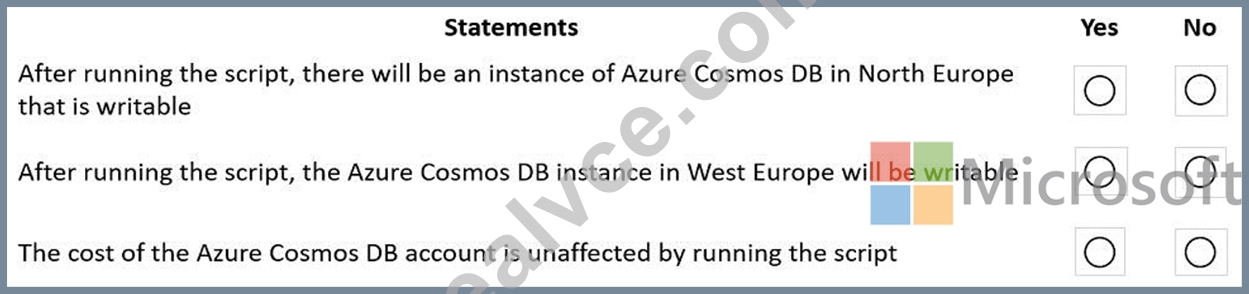
Answer:
Explanation:
Reference:
https://docs.microsoft.com/en-us/azure/cosmos-db/sql/how-to-multi-master
https://docs.microsoft.com/en-us/azure/cosmos-db/optimize-cost-regions
NEW QUESTION 29
You need to identify which connectivity mode to use when implementing App2. The solution must support the planned changes and meet the business requirements.
Which connectivity mode should you identify?
- A. Direct mode over HTTPS
- B. Gateway mode (using HTTPS)
- C. Direct mode over TCP
Answer: C
Explanation:
Scenario: Develop an app named App2 that will run from the retail stores and query the data in account2. App2 must be limited to a single DNS endpoint when accessing account2.
By using Azure Private Link, you can connect to an Azure Cosmos account via a private endpoint. The private endpoint is a set of private IP addresses in a subnet within your virtual network.
When you're using Private Link with an Azure Cosmos account through a direct mode connection, you can use only the TCP protocol. The HTTP protocol is not currently supported.
Reference:
https://docs.microsoft.com/en-us/azure/cosmos-db/how-to-configure-private-endpoints
NEW QUESTION 30
You need to select the partition key for con-iot1. The solution must meet the IoT telemetry requirements.
What should you select?
- A. the temperature
- B. the device ID
- C. the timestamp
- D. the humidity
Answer: B
Explanation:
The partition key is what will determine how data is routed in the various partitions by Cosmos DB and needs to make sense in the context of your specific scenario. The IoT Device ID is generally the "natural" partition key for IoT applications.
Scenario: The iotdb database will contain two containers named con-iot1 and con-iot2.
Ensure that Azure Cosmos DB costs for IoT-related processing are predictable.
Reference:
https://docs.microsoft.com/en-us/azure/architecture/solution-ideas/articles/iot-using-cosmos-db
NEW QUESTION 31
You are developing an application that will use an Azure Cosmos DB Core (SQL) API account as a data source.
You need to create a report that displays the top five most ordered fruits as shown in the following table.
A collection that contains aggregated data already exists. The following is a sample document:
{
"name": "apple",
"type": ["fruit", "exotic"],
"orders": 10000
}
Which two queries can you use to retrieve data for the report? Each correct answer presents a complete solution.
NOTE: Each correct selection is worth one point.
A)
B)
C)
D)
- A. Option A
- B. Option C
- C. Option D
- D. Option B
Answer: C,D
Explanation:
ARRAY_CONTAINS returns a Boolean indicating whether the array contains the specified value. You can check for a partial or full match of an object by using a boolean expression within the command.
Incorrect Answers:
A: Default sorting ordering is Ascending. Must use Descending order.
C: Order on Orders not on Type.
NEW QUESTION 32
......
What is the Microsoft DP-420 Certification Exam and why it is created?
DP-420 Certification Exam is also known as Designing and Implementing Cloud-Native Applications Using Microsoft Azure Cosmos DB (beta). DP-420 Certification Exam is authorized by Microsoft and is an IT professional certification exam that is designed to test the knowledge and skills of the candidates for designing and implementing cloud-native applications using Microsoft Azure Cosmos DB database technologies. This certification exam is a part of the Microsoft IT Professional certification program and is the final certification exam for Azure SQL Database Administration. DP-420 Dumps is the most reliable and easiest way to pass the DP-420 exam.
Here is the registration process of the Microsoft DP-420 Certification Exam
The registration process for the Microsoft DP-420 Certification Exam is very simple and straightforward. You just need to follow the steps given in the DP-420 Dumps. These steps are also given below to get registered for the DP-420 Certification Exam:
- Fill in the required details like name, email, and password. After that, enter the required information like your country, your exam center, and your exam date.
- Go to the official website of Microsoft. Click on the “Schedule Exam”, which will take you to the Exam Registration Page.
- Finally, click on the “Register Now” button. You will get a confirmation mail from Microsoft with a link to take the DP-420 Certification Exam. Take the DP-420 Certification Exam at the specified date and time, with the Pearson Vue.
Latest Verified & Correct DP-420 Questions: https://pass4sures.realvce.com/DP-420-VCE-file.html